Lipid (ie., fat) metabolism part 1

If like me you’re involved in sport you’ll be constantly looking for new ways to improve your performance. It is useful to look at stored body fat and how we can better use this overlooked but critical energy source to improve exercise or sports performance at different intensities.

It’s true, fat or lipids often get overlooked in favour of their leaner fuel storage sibling glycogen, despite the fact that they are the body’s main energy reserve by some distance. These images provide a visual representation of the differences.

As an example, a lean male weighing 70kg carries about 15kg of body fat (based on 20% body fat) equivalent to 35,000 kcals or 20 days’ worth of energy (Frayn 2006). This is significantly greater than storage of glycogen, which at between 400-520g (1600-2080 kcals) represents about one day’s worth of energy (Frayn 2002). Further, muscle glycogen is restricted in use to the muscle group where it is stored so glycogen stored in your biceps can’t be used by your quads and visa versa. Fat energy in contrast has no such restrictions and is therefore a far more flexible energy source.

Given the size of our bodies lipid-stores it logically follows that they play a fundamental and critical role in fuelling many physiological processes and therefore any acute or chronic disruption in their supply will have an adverse impact on health and sports performance. So, let’s take a look at them in a little more detail.

Storage of Dietary Lipids

Dietary fats or lipids are stored in different tissues in the form of triacylglycerols (TG) or triglycerides as they are often referred to in the general medical literature. The TG molecule seen below is made up of a glycerol backbone and three fatty acids.

Triacylglycerol

Fatty acids can either be saturated, unsaturated or polyunsaturated. The important thing about each of them is that they have to be split away from the glycerol backbone before they can be used for generating energy. When they are split away (‘de-esterified’) they are referred to as free fatty acids or to use the correct scientific term, Non-Esterified Fatty Acids (NEFA) – either term describes the fatty acid in a state where it can be oxidised, that is, used as a fuel.

NEFA are hydrophobic (ie., repel water) so they can’t circulate in blood alone; therefore, they are bound to a protein known as albumin and then transported to different tissues where they are used as fuel, stored away for later use or repackaged in larger lipid-carrying vessels known as lipoproteins. Most tissues use NEFA but the most important are liver cells (hepatocytes), muscle cells (myocytes) and specialist lipid storing cells known as adipocytes which are mainly located in adipose tissue surrounding the abdominal muscles. In the next blog we’ll be taking a closer look at how lipids are distributed in different tissues and how they are constantly recycled and ‘primed’ to meet the fluctuating energy demands of the body.

Frayn KN, Arner P, Yki-Järvinen H (2006) Fatty acid metabolism in adipose tissue, muscle and liver in health and disease. Essays in Biochemistry; Chapter7:4289-103
Frayn KN. Adipose tissue as a buffer for daily lipid flux. (2002) Diabetologia; 45:1201-1210

Unique Relationship Revealed Between Oral Microbiome and Aerobic Fitness

A recent study has revealed a unique insight into the activity of the oral microbiome and its relationship to vascular control. In a mixed cohort of 50 healthy people a significant correlation was found between markers of aerobic fitness (peak power output and peak oxygen uptake) and a key output of the oral microbiome, the oral nitrate reducing capacity (ONRC).

Spearman’s rank correlation between the oral nitrate-reducing capacity in absolute nitrite values and peak power output (Wpeak) (A) and peak oxygen uptake (VO2peak) (B) in males and females (n = 25)

Vasodilation & nitric oxide

The ability to deliver oxygen to working muscles and tissues is determined by the capacity of the vasculature to respond dynamically to decreasing oxygen concentrations (hypoxia) through vasodilation, that is expansion of the vasculature, which is mediated by nitric oxide. Nitric oxide is released by the endothelial cells lining the inner wall of the blood carrying vessels when at rest or during moderate activity. It is then oxidised to nitrite and then nitrate under normal concentrations of oxygen. About 25% of this circulatory nitrate is absorbed in the salivary glands where it is secreted into the mouth and reduced by communities of oral bacteria into nitrite. Nitrite is then swallowed, a small part of which is rapidly absorbed into circulation to be further reduced to nitric oxide where it supplements the supply from endothelial cells. This nitrite to nitric oxide reduction typically takes place under low concentrations of oxygen, that is, when exercising at higher intensities. The ability to deliver nitric oxide under increasingly hypoxic conditions lends a higher capacity to individuals to exercise harder and longer.

The nitric oxide pathways (from Larsen et al)

How exercise modulates the oral-nitrate reducing capacity

The correlation in the study reveals how the oral microbiome of well trained people has a higher capacity to reduce nitrate to nitrite, the oral nitrate reducing capacity (ONRC), and deliver nitrite to working muscles as oxygen concentrations fall. This means well trained individuals can exercise at higher intensities for longer periods of time. So, how has this relationship arisen? It is thought that exercise, when practised repeatedly over time, improves and increases the ONRC. The authors speculate that changes in the acid/base balance may underpin this key mechanism. An increase in muscle lactate concentration which commonly occurs during exercise, even at moderate intensity leads to its rapid distribution amongst different tissues and fluids including saliva. This was corroborated in the study by significant increases in post exercise salivary lactate concentrations.

Salivary lactate concentrations and pH pre and post exercise (n = 50)

It is well known that different bacteria flourish under different environmental conditions. It is hypothesised that environmental changes in the oral cavity such as pH, lactate concentrations and increased salivary flow rates, which are brought on by repeated bouts of exercise, modulate the composition and the ONRC of the oral microbiome.

Dietary sources of nitrate

In addition to endogenous sources, nitrate can also be derived from diet, from leafy greens such as spinach, lettuce and rocket and from vegetables such as celery, broccoli and beetroot. There has been much research over the past decade focused on dietary nitrate as a potential ergogenic aid in sport and as a blood-pressure lowering compound in health and disease. In sport, dietary nitrate (mainly in the form of beetroot juice) has been shown to enhance aerobic performance in low or moderately trained individuals but not in well trained subjects. Examination of the dietary records of study participants showed little variation in dietary nitrate consumption so in the acute setting of the study it can be inferred that diet did not exert a distinguishable effect on vascular control. It would of course be interesting to examine longer term dietary patterns to assess what if any dietary differences can be discerned between well trained and less well trained people.

Summary

This is the first study to report an intriguing correlation between the microbiome and aerobic fitness in healthy people. It appears that repeated bouts of exercise over many years improve the capacity of the oral microbiome to reduce nitrate to nitrite and this becomes especially important when exercising at higher intensities. Given the similarities in diet of the study participants it reinforces the value of physical activity in confering physiological benefits.

Further research is now needed to establish what if any correlation exists between the ONRC and aerobic fitness in unhealthy subjects, especially those with compromised vasculature such as hypertensives, diabetics or those recovering from heart and cardiovascular disease. If a significant correlation is also found in an unhealthy cohort then it opens the door for using ONRC in a clinical setting as a novel low-cost procedure for assessing vascular health and improving disease prevention/progression.

Biggest Performance Bang for your Training Buck!

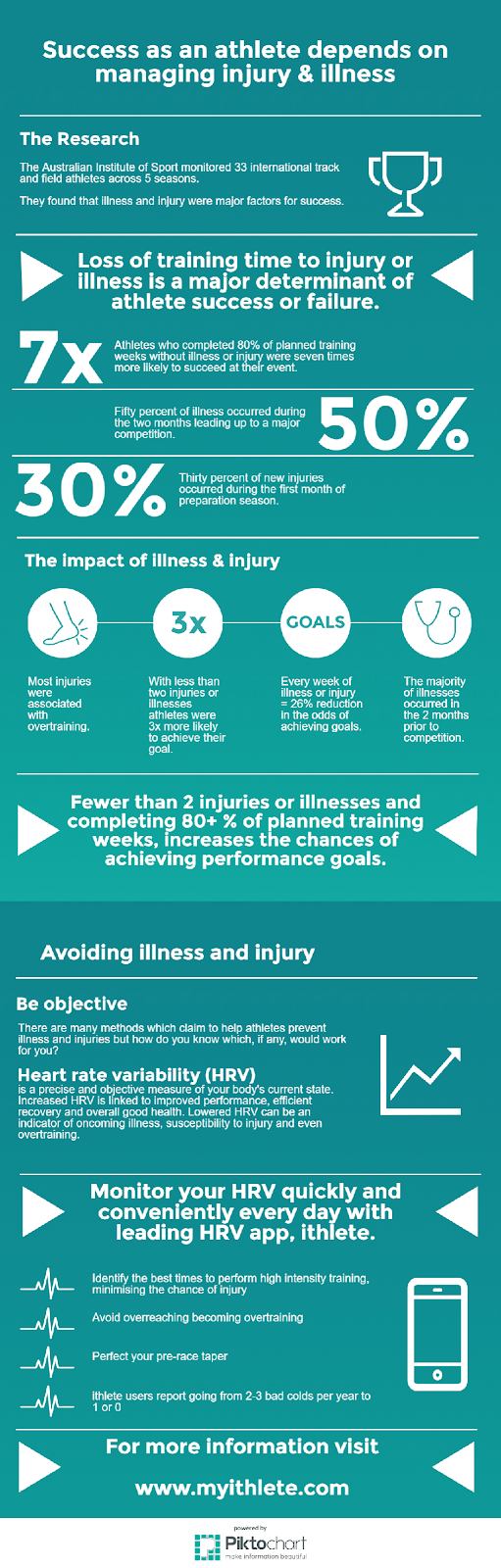
Is your sporting performance undermined by interruptions to training from illness and injury. Just look at some of the stats below from the Australian Institute of Sport. According to the latest research you are a staggering seven times more likely to achieve your sporting goals if you complete over 80% of your training programme! Therefore, it is absolutely critical that you factor in the need to recover from training and other stressors such as diet, sleep, emotion, and microbiome, etc if you are to achieve your sporting goals.

Read this informative article on the need to balance total load or stress (training, diet, sleep, emotions, microbiome, etc) with recovery and adaptation. In a later post we can explore how to balance training load with recovery to maximise sporting performance.

https://www.trainingpeaks.com/…/the-whole-picture-an-intr…/…